

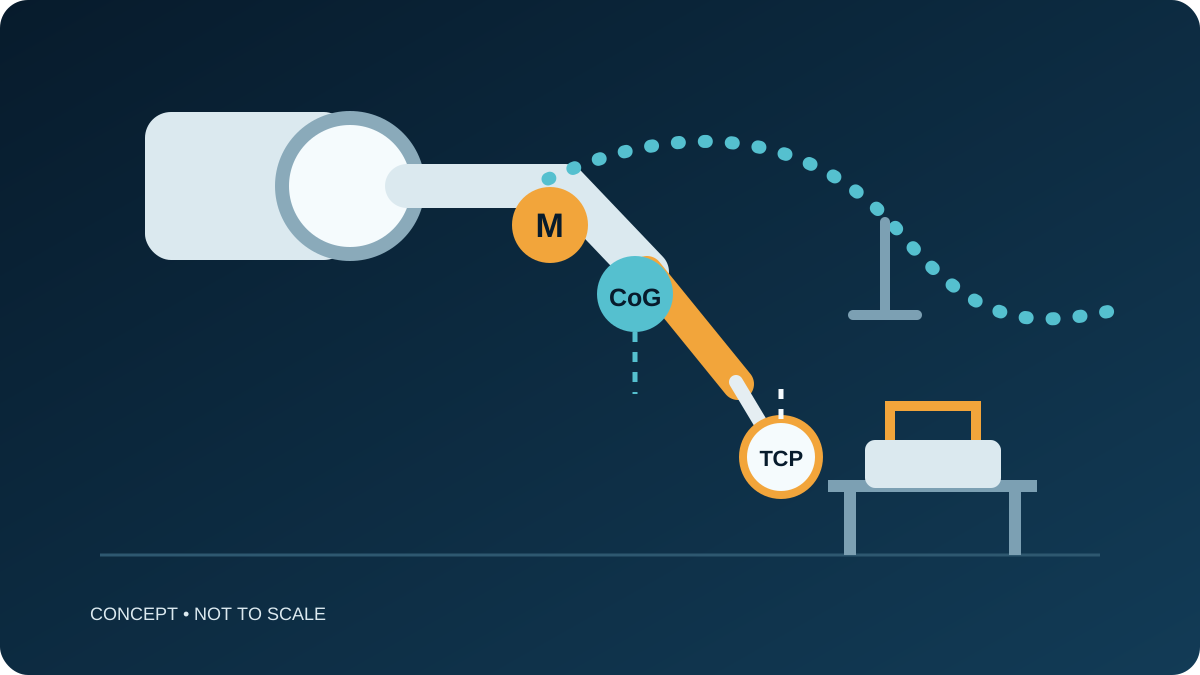
Conceptual loading map—not an engineering drawing, model specification or measured CBOXTEC installation. M marks the considered mass, CoG its center of gravity and TCP the task point.
Does workpiece weight equal welding robot payload?
Usually not. A stationary workpiece held by a fixture is not being lifted by the robot, so its full weight is not the arm's carried payload. Start with everything attached to the robot flange, then add any part the robot actually carries. Center of gravity, mass distribution, inertia and hose routing still require a model-specific integration review.
Separate the loading cases
For ordinary robot-guided welding, the fixture supports the workpiece while the robot carries the torch assembly. That assembly may include the torch, mounting bracket, collision device, sensors and other flange-mounted items if fitted. Their combined mass and arrangement—not the workpiece weight alone—form the starting point for review.
If the robot picks up the workpiece, the carried part creates a different loading case and belongs in the evaluation for that motion. A positioner or separate handling robot should be assessed according to what it carries; its load should not automatically be assigned to the welding arm.
| Item | Question for the integration review |
|---|---|
| Tool assembly | Which torch, mount, sensor or other fitted item moves with the flange? |
| Carried workpiece | Does this robot lift the part, or does a fixture support it? |
| CoG and inertia | How is the considered mass distributed relative to the flange through the intended motion? |
| Hoses and cables | Where are flexible services routed and supported, and what changing forces can they introduce? |
| TCP | Where is the task point used to describe the welding location relative to the flange? |
Keep mass, CoG and TCP distinct
Mass states how much is carried; center of gravity describes where that mass acts; inertia also depends on how mass is distributed. TCP, or tool center point, identifies a task point relative to the flange. The TCP can be near the wire tip without being the tool assembly's CoG. The labels answer different questions and should not be substituted for one another.
Universal Robots' guide on integrating end-of-arm tools likewise treats tool and carried-part mass, center of gravity or mass distribution, inertia and TCP as distinct integration inputs. This supports the definitions above, not a claim about CBOXTEC controller features or robot capacity. Source: Universal Robots, Integrating end-of-arm tools, accessed 22 September 2026.
Review hose routing without pretending it is rigid payload
A flexible torch package does not behave like one rigid block fixed entirely at the flange. Routing, supports, bend changes and robot pose can introduce changing forces or restrictions. Record what is flange-mounted and ask the robot or cell integrator to review the complete routing arrangement for the intended model and motion. Buyers can begin this discussion with partial information; exact assembly data can be confirmed as the design develops.
What to send for a model-specific payload review
Send the tool list, assembly drawing and intended motion with the exact model name. These let the reviewer connect the mass, CoG, inertia and TCP inputs to one proposed configuration.
- List the torch, bracket, collision device and fitted sensors, with their masses and the source of each value. Show their positions relative to the flange; mark unknown mass, CoG or inertia data for confirmation.
- Show the intended TCP, hose supports and range of welding poses. State whether the part stays in its fixture or this arm carries it, and identify any separate positioner.
- Ask the supplier to identify the model-specific load conditions used for the assessment and record unresolved inputs. A photograph or the conceptual illustration above cannot replace those data.
CTC007-HJ1077 product page identifies a catalogue model to discuss. Its presence here does not confirm suitability for your tool or application.
FAQ
Is a clamped workpiece part of the welding arm payload?
Not as a part carried by that arm. Its fixture and any separate positioner still need their own engineering review.
Should torch mounts and sensors be included?
Include any fitted flange-mounted item in the tool-assembly review. The final assessment depends on the actual assembly and selected robot model.
Is TCP another name for center of gravity?
No. TCP describes the task point; CoG describes the location of the considered mass distribution.
Discuss a torch assembly and loading case. CBOXTEC can discuss the application before every detail is known; model suitability remains subject to the actual integration review.