

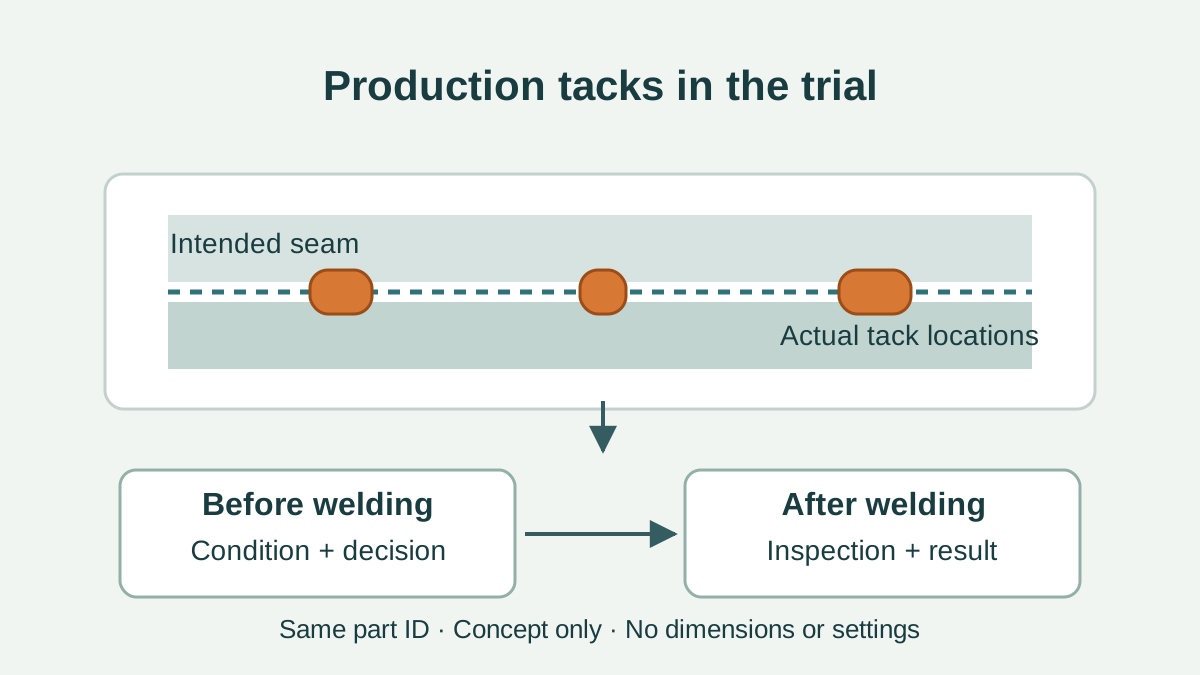
Original concept diagram: tack locations on an intended seam are linked to before-and-after trial records. The shapes do not specify tack size, spacing, a welding procedure or a customer result.
Test the joint as it will arrive
If production assemblies arrive tack welded, include that condition in the robot welding trial. A demonstration on an untacked joint leaves the production tacks untested. Use representative parts and record any preparation that changes them before the robot pass. This CBOXTEC guide helps buyers define that trial condition; it does not approve a welding procedure.
Why a small tack still matters
A tack weld holds parts in position before final welding. TWI describes its role in maintaining alignment and joint gap, and warns that tack defects can compromise the finished weld. TWI, What is a Tack Weld?; publication/revision date not stated; accessed 2026-10-12.
The trial therefore needs a record of the incoming tacks, not just a photograph of the finished bead. Note their actual locations and observed condition against the intended seam. Do not assume that a repeated robot path will make an unsuitable tack acceptable.
Will the tacks remain or be removed?
Confirm this with the person responsible for the welding procedure before interpreting the trial. TWI says tacks that will be fused into the main weld should follow an approved procedure and be made by appropriately qualified welders; it also warns that removal needs control to avoid surface defects. TWI, How can tack welding be used to minimise distortion?; publication/revision date not stated; accessed 2026-10-12.
That guidance does not decide which tacks may remain on your part. Keep the agreed decision and procedure reference with the sample record. If the demonstration uses extra preparation, include it in the proposed production scope rather than leaving it out of the comparison.
Connect the incoming joint to the result
For the buyer's trial record, use the same part identifier before and after welding. The following fields are suggestions for traceability, not acceptance criteria:
- Before welding: part identifier, tack locations and observed condition, procedure reference, and agreed retention or removal.
- Robot pass: tested setup and any interruption or extra preparation at the tack locations.
- After welding: inspection method, agreed criteria and result, linked to the same part and tack locations.
Have the responsible welding personnel resolve questionable tacks before the trial proceeds. This article sets no tack dimensions, removal method or repair settings.
Questions that change the trial scope
Can we remove all the tacks just for the demonstration?
Record that as a different incoming condition. It does not establish how the robot will weld assemblies with production tacks left in place.
Does a smooth bead over a tack prove acceptable fusion?
Appearance alone is insufficient. Use the inspection method and criteria agreed for the joint; see the separate guide to weld appearance and inspection evidence.
Can the robot compensate for a defective tack?
Do not assume it can. The welding procedure and the actual tack condition need review; a programmed path is not a repair qualification.
Discuss a welding trial with CBOXTEC using the part information and production tack condition you have available.