

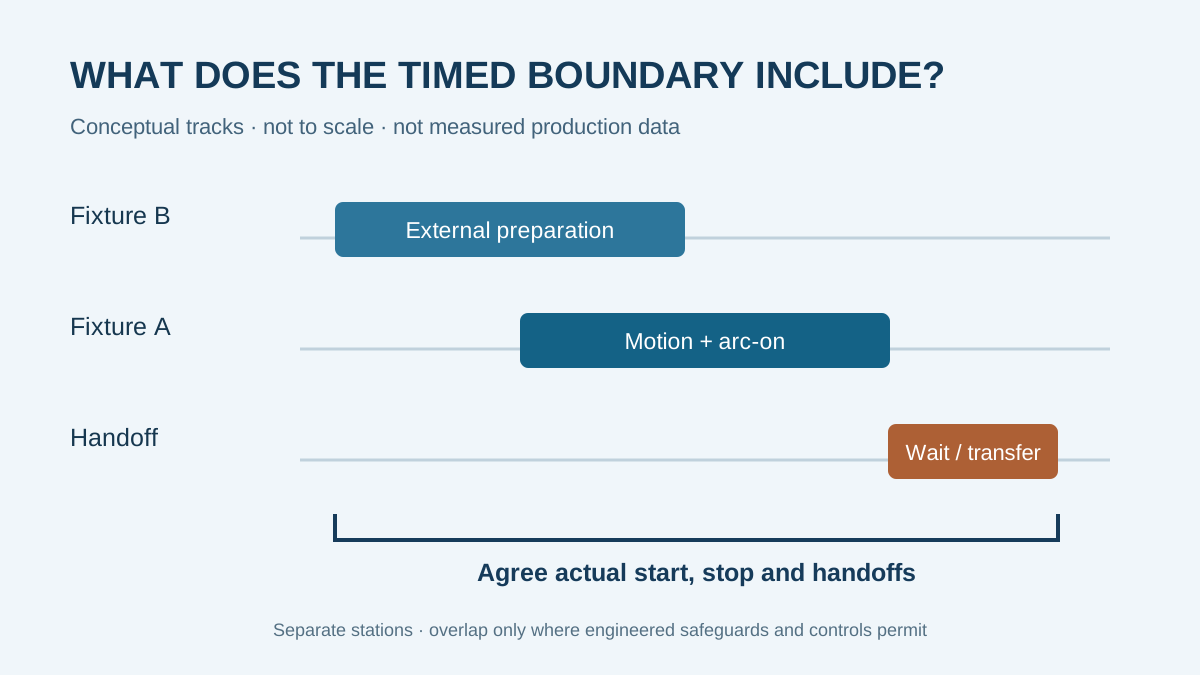
Conceptual timing tracks, not measured production data or a promised CBOXTEC cycle time. Overlapping tasks must be observed at their actual synchronization points.
How should buyers compare welding robot cycle-time claims?
Ask for the same part, weld scope, start and stop events, staffing, and acceptance rule for each trial. Record arc-on time separately from the complete observed cycle and from downtime. Then compare accepted output over a stated observation window. A short weld segment alone cannot establish a cell's output rate.
Define three different timing questions
Arc-on time measures only the period when the welding arc is on. Observed cell cycle time needs named start and stop events—such as fixture-ready to the next fixture-ready event—and includes the intervening handling, robot motion, welding and synchronization waits that actually occur inside those events. Part lead time from entry to exit is different from the steady-state interval between completed parts; overlapping work can make those numbers diverge. Specify whether loading happens within the cell boundary and whether rework or inspection happens outside it.
Miller lists arc-on time, cycle time and downtime as distinct welding information to monitor. That distinction supports separate records, not a CBOXTEC performance claim or a universal definition of a customer's cycle boundary. Source: Miller, Driving Improvements in Automation with Welding Information, accessed 21 September 2026.
Record overlap and waits rather than adding labels
Loading a second fixture may overlap welding on the first, while a robot might wait for a clamp, operator, part transfer or inspection decision. Do not sum overlapping durations as though they were sequential. Nor should the larger of two task durations automatically be called the cycle: observe handoffs and synchronization waits. The illustration shows the question to ask, not a measured timeline or a cycle-time calculation.
Concurrent preparation at a separate station is only an option where the engineered safeguarding and controls permit it; the diagram is not a safety approval.
| Record in a trial | Boundary or evidence to agree |
|---|---|
| Part and weld scope | Drawing revision, weld sequence, accepted-part criterion and trial quantity. |
| Arc-on and machine events | Logged arc start/stop, motion, handling and pause events; state which events fall inside the cell cycle. |
| Parallel work and waits | Operator/fixture actions, overlaps, dependencies and actual handoff times. |
| Output window | Clock start/stop, total pieces, accepted pieces, rework, scrap and downtime reasons. |
Use accepted output without disguising losses
For an agreed observation window, elapsed window time divided by accepted pieces is a retrospective average time per accepted piece. State whether planned breaks and unrelated stoppages are inside the window; keep the rejected and reworked counts visible. State whether a reworked piece later accepted counts in accepted output, and count each physical piece once. If no pieces meet the acceptance rule, the quotient is undefined, not zero. This observed output metric is not a machine cycle, an individual part's lead time, a promised takt, or a projected savings figure. Repeat trials under disclosed conditions before using the record for a quotation discussion.
FAQ
Is arc-on time the robot's complete cycle time?
No. The chosen cycle boundary can include motion, loading, clamping and waits beyond arc-on time; identify the actual start and stop events.
Can two overlapping activities be added to estimate output?
Not without their order and handoff record. Time actual overlap and synchronization; do not assume either a simple sum or the longer activity alone.
Does one successful part prove the quoted output rate?
No. Record an agreed window, accepted and rejected quantities, downtime and conditions. A single part's lead time is not the steady-state output interval.
Discuss a sample trial and timing boundary. This is procurement record guidance, not a CBOXTEC product specification, acceptance approval or output guarantee.