

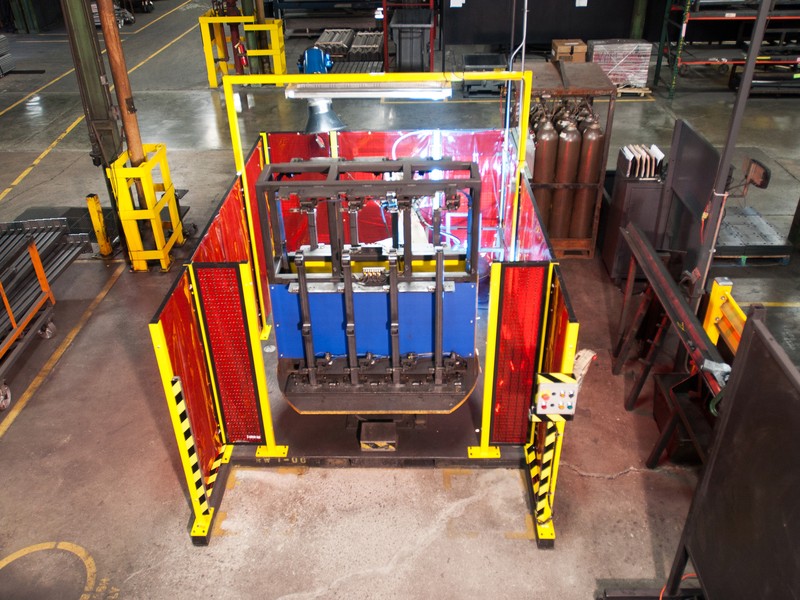
Review the complete installation
Welding robot safety requires a review of the application, including the arm, welding equipment, tooling, workpieces and people. A collaborative designation or component certificate does not demonstrate that the complete installation is suitable for its intended operation.
Use competent personnel to identify the applicable requirements for the destination and the specific project. This article is a procurement planning aid, not a compliance determination or machine operating procedure.
Describe tasks and hazards
- Identify loading, teaching, production, cleaning and maintenance tasks.
- Review motion, trapping and interaction with fixtures and tooling.
- Address welding radiation, hot material, spatter, fumes and electrical hazards.
- Identify access by operators, maintenance staff and nearby workers.
- Include foreseeable changes to parts, equipment and layout.
Ask the responsible specialists to determine protective measures, access controls, energy-isolation procedures and training for those tasks. The project should define who implements and verifies each measure, rather than leaving responsibility implicit in an equipment purchase.
Request a documented handover
Before acceptance, agree the required manuals, risk-assessment records, validation evidence and remaining actions. Confirm which documents the supplier provides and which belong to the integrator or user. Do not assume a particular report is included without written confirmation.
Establish how later changes will be reviewed and how affected personnel receive updated instructions. Record the tested installation and its intended conditions of use.
Use official references
The OSHA robotics technical manual is a technical reference for robot-system safety. The ISO robot safety scope page distinguishes robot requirements from integration and application hazards. These references do not establish CBOXTEC certification or replace a destination-specific review.
Share the planned tasks and installation scope with CBOXTEC and request written confirmation of supplied safety documentation and project responsibilities.
Which welding robot safety standards and evidence should I request?
Have competent personnel identify the applicable standards and editions for the destination and the complete project. Agree in writing which risk-assessment records, validation evidence, instructions and outstanding actions are supplied, and who is responsible for each; a standards reference alone does not establish compliance.
Robot requirements versus application safety
The scope distinction follows the linked ISO pages. Applicability and required editions must be checked for the destination and project; citing a standard is not evidence of CBOXTEC certification.
ISO 10218-1:2025 · ISO 10218-2:2025
| Reference | Scope | Confirm for the project |
|---|---|---|
| ISO 10218-1:2025 | Industrial robot requirements | Which robot and supplier documents are covered? |
| ISO 10218-2:2025 | Industrial robot applications and cells | Who reviews integration and the complete application? |
- Request a written document list identifying the responsible party, equipment configuration and revision for each item.
- Agree which risk-assessment records, protective-measure validation records and instructions are supplied, and which remain the integrator's or user's responsibility.
- Before handover, record outstanding actions, responsibility for closure and how later equipment or layout changes will be reviewed.
This is a procurement checklist, not an operating procedure or compliance decision. Welding-process hazards require separate assessment; neither a component certificate nor this standards list establishes complete installation safety.