

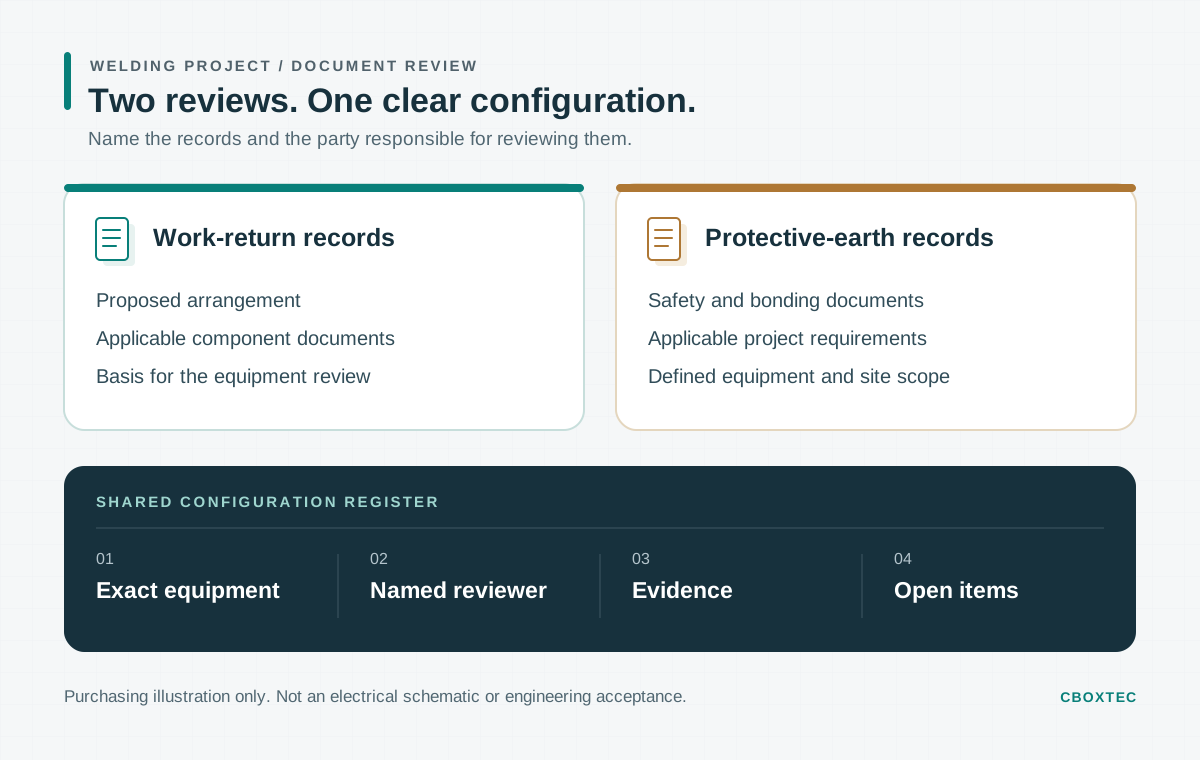
Original purchasing illustration: two document reviews share a configuration register. The English labels distinguish work-return and protective-earth records. It is not an electrical schematic, machine drawing or approved safety design.
Ask for a configuration-specific review
Before accepting a welding-arm quotation, ask who will review the welding work-return circuit and protective-earth arrangements for the actual equipment. Request the applicable drawings, manufacturer instructions and written review scope. A general statement that equipment is “grounded” leaves too much unclear. This CBOXTEC guide helps buyers prepare that enquiry; electrical design, installation and verification belong to qualified personnel appointed for the project.
Give the two functions clear names
The work-return lead is part of the circuit carrying welding current back to the welding power source. Protective earth serves an electrical safety purpose. AWS distinguishes the work lead from the grounding lead and warns against welding current passing through a connection intended only for safety grounding. That distinction does not decide the correct arrangement for a particular installation. AWS, ANSI Z49.1:2021, sections 11.3.2.1–11.3.2.2 and E11.3.2.1; accessed 2026-10-18.
Request four concrete records
Use these purchasing questions to define the document package. They are an editorial checklist, not a quotation from a standard.
- Exact equipment: identify the proposed power source, wire feeder, torch and robot, including installed options and the applicable manual and drawing revisions. Mark retained equipment separately.
- Work-return review: request the proposed arrangement, the component documentation and rating basis, and the name of the party responsible for assessing it against the actual welding application.
- Protective-earth review: request the relevant protective-earth and bonding documentation, the requirements identified by the responsible qualified reviewer, and the equipment and site boundaries covered by that review.
- Verification and gaps: agree who defines and performs verification, what evidence will be handed over, and how open items are resolved. Receiving a drawing does not mean acceptance is complete.
Include the actual workholding arrangement
If the proposal includes a fixture or positioner, request its exact manufacturer documentation and the integrator's review of the proposed configuration. A photograph or visible metal contact does not establish an acceptable welding-current path. Ask which drawings cover that arrangement, who owns the decision, and what remains unconfirmed. Do not infer that CBOXTEC manufactures, supplies or has approved every item in an application description; settle those roles and exclusions in the quotation.
Keep manufacturer examples within their scope
Fronius's VR 1500, VR 1500 PSA and VR 1550 instructions warn that misdirected welding currents can overheat connected parts and damage ground conductors and other equipment. This explains why the applicable equipment instructions matter. It does not establish compatibility with a CBOXTEC arm or approve another system's arrangement. Fronius, VR 1500 / VR 1500 PSA / VR 1550 Operating Instructions, safety rules; revision date not stated in the opened HTML; accessed 2026-10-18.
The AWS reference is a US safety standard, not a statement that the same legal requirements apply in every destination. Ask the project reviewer to identify the applicable requirements.
Questions before accepting the scope
Does protective earth replace the work-return lead?
No. They have different functions. Have the responsible qualified person assess the complete arrangement for the actual installation.
Does a successful arc prove the arrangement is accepted?
No. An arc alone does not provide the agreed electrical, functional or safety verification records.
Is this the same as checking the robot interface?
No. Start/stop signals and feedback are a separate review. Keep both scopes visible in the quotation.
Discuss the welding project with CBOXTEC using the exact equipment list and available manufacturer documents. Also review the existing power-source interface checklist.