

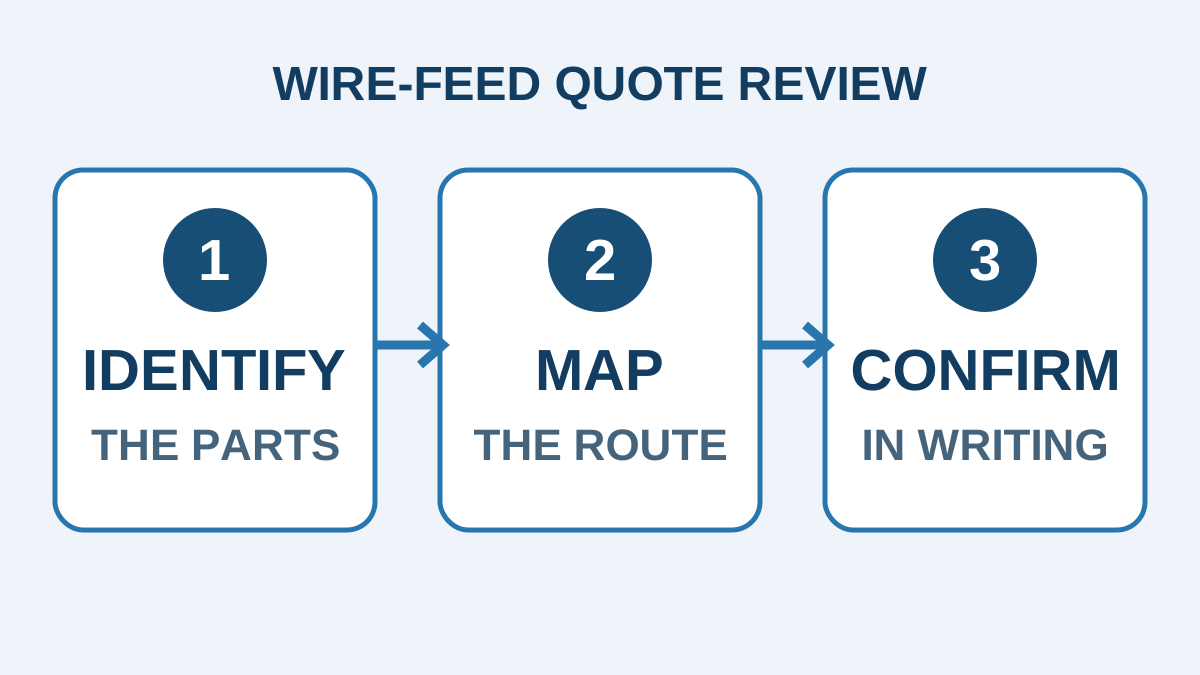
Original procurement-planning illustration: customer records pass to supplier confirmation and written scope. It is not a wiring diagram, compatibility statement or CBOXTEC product specification.
In short
Before pricing a robotic MIG/MAG application, send the integrator the exact wire and equipment identifiers, relevant consumable specifications, and a clear view of how the wire conduit is routed. Ask the equipment supplier to confirm which parts and interfaces apply to that particular configuration and to list unresolved items in the quotation. This is an information checklist, not an instruction to adjust or replace components.
Start with the wire and equipment records
Provide the intended process and wire details, including material/type and diameter as stated in the application documents. Identify the welding power source, wire feeder, robot and controller, torch or gun, and any installed options by manufacturer and model. If the system already exists, include readable nameplate and connector photographs and the relevant manual or parts-list references. A photograph can help identify equipment; it does not prove that components are compatible.
For an existing or proposed consumable setup, list the specified drive-roll type and groove, wire-guide or liner part number and specified length, and contact-tip part number and wire-size designation. Record the equipment maker's specifications as written. Do not infer a universal size or length from another cell, and do not assume a mismatch means every part needs replacement.
Show the complete wire path
Include an overview photo or sketch from the spool or bulk pack through the feeder, conduit and torch to the contact tip. Note the conduit route, bends, supported sections and any points where the route changes with robot motion. These are useful integration inputs so the supplier can assess the actual installation; they are not universal pass/fail limits. The relevant bend and routing requirements depend on the equipment maker and configuration.
Also describe the observed issue, if any: when it occurs, which wire and program are involved, and what the operator can safely observe without opening or adjusting equipment. Keep observations separate from suspected causes. For example, intermittent feeding is an observation; a liner, drive roll or contact tip being at fault is a hypothesis until checked by qualified personnel using the applicable equipment instructions.
Ask the supplier to confirm the proposed configuration
Miller's guidance on wire-feeding problems lists examples including liners that are incorrectly sized, trimmed, installed or contaminated, an incorrect contact-tip size, and unsuitable drive rolls or drive-roll pressure. Its robotic-welding article explains that proper liner installation matters and that, on some robotic guns, a liner trimmed too short or too long can contribute to feeding problems. These are manufacturer examples, not a diagnosis of a particular cell or proof that every listed part must be changed. Miller, “Reduce Weld Rework With These Tips,” posted 27 May 2024; accessed 28 September 2026. Miller, “Welding Robots Can Offer Benefits for Smaller Shops,” posted 27 June 2024; accessed 28 September 2026.
In the quotation review, ask the responsible equipment supplier or integrator to state:
- which wire-feeding and torch components are included, optional or supplied by others;
- whether each named part and interface is confirmed for the listed wire, feeder and torch models;
- which dimensions, part numbers or cable-route requirements still need confirmation;
- who will verify the assembled configuration and under what agreed trial scope; and
- which open assumptions could change the quoted scope.
Keep supplier-confirmed facts, customer-provided records and open questions visibly separate. Do not treat a generic protocol, similar-looking connector or an illustration as compatibility evidence. This checklist does not claim that CBOXTEC supports a specific third-party feeder, torch, liner system or interface; confirm the exact project configuration in writing.
FAQ
Does a wire-feed problem mean the liner or drive rolls must be replaced?
No. Record the symptom and exact configuration, then have qualified personnel assess it against the equipment maker's instructions. The examples above do not diagnose an individual system.
Can I use a cable-route dimension from another robot cell?
Use the route and dimensions specified for the equipment being quoted. Ask its supplier to confirm requirements for the actual conduit, torch and robot motion; this article sets no universal bend or length limit.
Does sending photographs confirm compatibility?
No. Photographs support identification and discussion. The responsible supplier or integrator must confirm the proposed parts and interfaces for the exact configuration. Discuss a robotic welding quotation with the wire, feeder, torch and controller records available for review.