

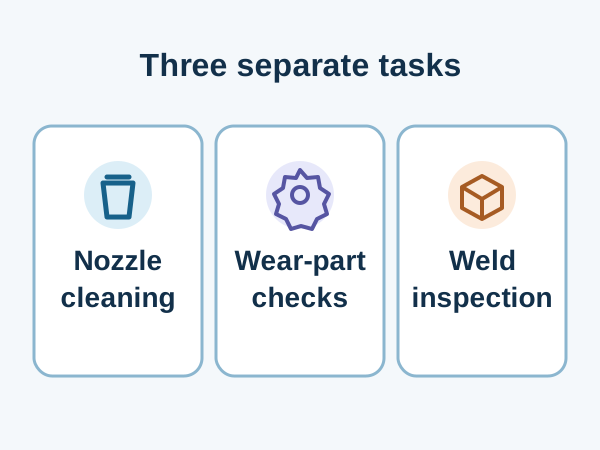
Conceptual map of three separate tasks; not a product or a weld-quality guarantee.
Why does robotic MIG/MAG welding still need torch cleaning?
Because repeating a robot path does not remove spatter from the gas nozzle. In MIG/MAG welding, accumulated spatter can obstruct shielding-gas flow. Set a cleaning routine for the actual torch and process, not an assumed universal interval.
What does nozzle cleaning do—and not do?
Nozzle cleaning removes adhering material; it does not restore worn parts or verify a weld. Evaluate a station's cutter and clamping against the exact torch/nozzle geometry and cell integration. This does not claim CBOXTEC supplies or supports any third-party station.
ABICOR BINZEL describes spatter interfering with shielding-gas coverage and says its reamer is selected for torch and wear-part geometry. This is not an independent guarantee or another station's specification. ABICOR BINZEL, “How to Avoid Errors with a Torch Cleaning Station,” Robin Reips, 12 June 2019; accessed 27 September 2026.
How are the three checks different?
These are distinct tasks; none substitutes for another:
- Nozzle cleaning: Addresses adhering spatter around the nozzle and torch head. It does not establish whether a worn contact tip or liner is serviceable.
- Wear-part checks: Assess the contact tip, nozzle, gas-distribution parts and wire liner. They do not establish whether a weld meets its acceptance criteria.
- Weld inspection: Examines the produced weld using the agreed method. It does not establish that the torch is clean or its parts are unworn.
ABICOR BINZEL discusses contact tips, gas nozzles, gas diffusors and liners as distinct wear parts, not universal replacement intervals. ABICOR BINZEL, “Downtimes due to wear parts during robot welding,” Prof. Emil Schubert, 24 June 2022; accessed 27 September 2026.
How should a distributor or integrator set the interval?
Use the equipment manufacturer's guidance as the starting point; have responsible trained personnel assess representative trial welds and nozzle condition to confirm the maintenance plan. Record the process, torch/nozzle and observations; review the plan when conditions change. Inspect welds by the project's agreed method.
Maintenance must be carried out in the equipment's specified safe state by trained, authorized personnel. Follow the relevant equipment instructions; this article is not a dismantling, programming or safety-bypass procedure.
FAQ
Can repeated robot movement replace nozzle cleaning?
No. Repeated motion does not remove nozzle spatter.
Does cleaning the nozzle mean the contact tip and liner are good?
No. Check wear parts separately using equipment guidance and observed condition.
Does a clean nozzle prove that the weld is acceptable?
No. Inspect welds separately against the project's agreed acceptance method.
Discuss your MIG/MAG maintenance scope with the process, torch/nozzle and checks already in use.
Is a torch cleaner a complete welding robot maintenance plan?
No. Nozzle cleaning, wear-part checks and weld inspection are separate tasks. Follow the equipment maker's guidance and representative trials for the actual torch and process, and obtain written confirmation of the proposed maintenance and supply scope; do not assume CBOXTEC supplies or supports a third-party cleaning station.