

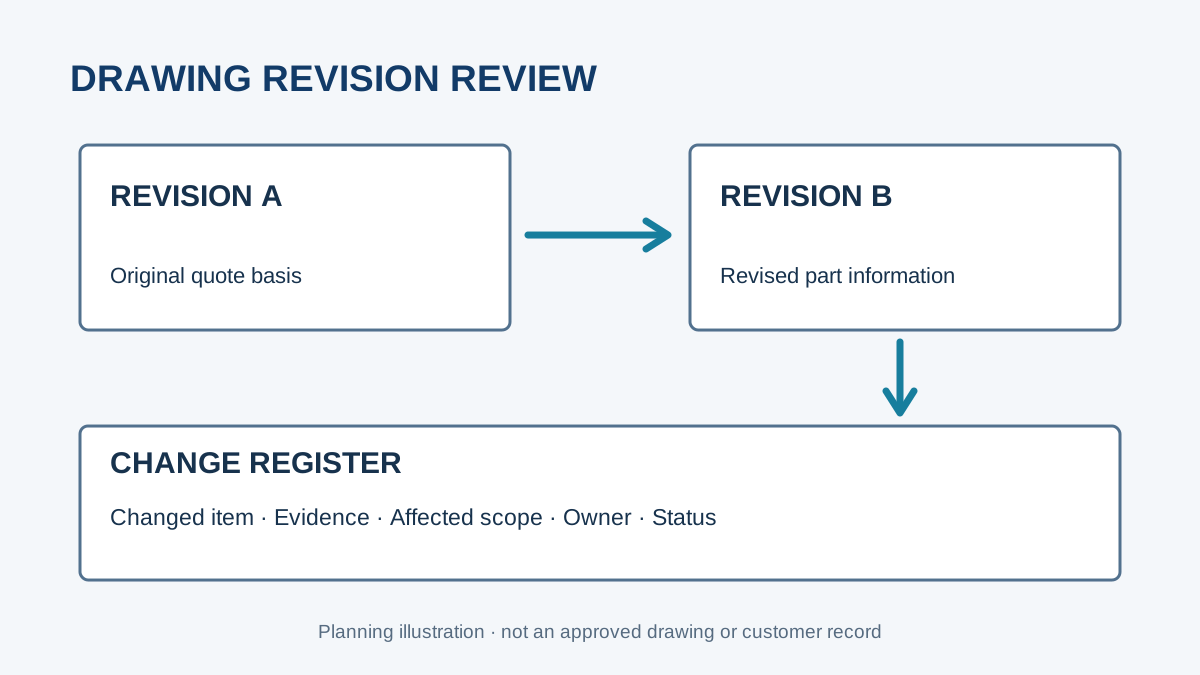
Planning illustration: revision A and revision B feed a change register before scope confirmation. It is not a customer drawing, approved design or weld procedure.
Identify the version behind each quote
Record the part number, revision, issue date and permitted file name behind each proposal. Mark estimated dimensions or weld locations as open. This CBOXTEC worksheet is purchasing guidance, not engineering approval or an equipment-fit promise.
Record each change separately
- Geometry: material, thickness, joint access, fit-up or weld location changes.
- Handling: loading direction, fixture datums, clamp access and part orientation changes.
- Process: required weld length, sequence, inspection criteria or applicable procedure references.
- Commercial scope: who checks the part, updates a program or fixture, repeats a trial and confirms price. Record old/new revisions, change, evidence, impact, owner, status and confirmation date. A blank impact means unresolved, not no cost.
Confirm the decision boundary
Distinguish document review from checks needing a representative part, trial or engineering review. Keep the old quote tied to its original revision; a later drawing does not automatically change price, scope or acceptance. Share only authorized files.
Why keep a revision trail?
A NIST process-planning study lists part version, drawing number, revision date and description, approval, and change effectivity in sample plans. This supports recording identifiers, not a welding-specific rule or CBOXTEC project claim. Source: NIST, A Manufacturing Engineering Tool Kit, Figure 6, accessed 19 September 2026. NIST PDF.
FAQ
Can we request a preliminary quote with an unfinished drawing?
Yes, as a discussion starting point. Label assumptions and agree which information must be confirmed before a firm scope is set.
Does a small drawing change always require a new trial?
No universal rule applies. Assess whether the change affects access, fixture, program, procedure or acceptance, then agree the verification needed.
Who decides whether the old price still applies?
The parties should confirm the changed scope in writing; do not infer that an earlier price covers unreviewed revisions. Discuss your drawing revision and project scope.