

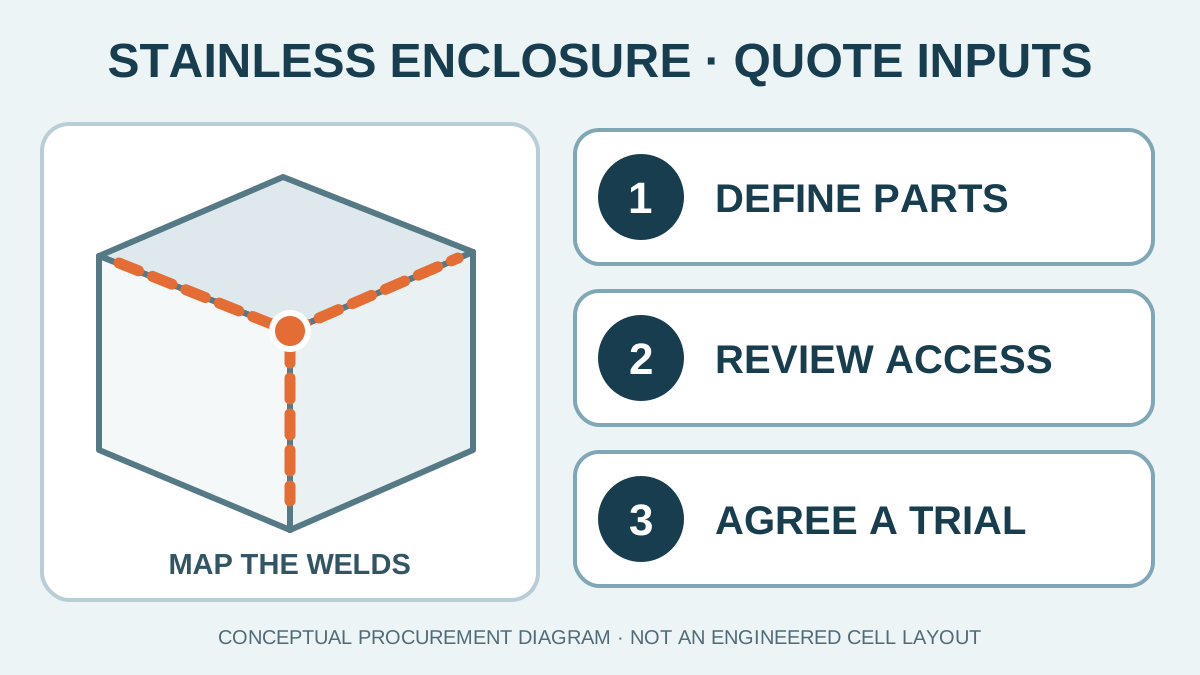
Original planning illustration: a buyer's part information moves into an integrator review and an agreed trial. It is not a cell layout, weld procedure, product specification or customer result.
What should I send for a robotic welding quote on stainless steel boxes?
Send the current drawings and revisions, stainless grade and thickness, the exact seams to be welded, how parts vary, the required finished appearance, and representative parts from normal production. Ask the integrator to review torch access, fit-up, restraint and weld sequence on that part family, then state what a sample trial will and will not verify. “Stainless steel box” alone does not establish that a robot can reach every seam or meet the required finish.
Define the part family and the welds
Start with drawings or clear photos of the complete enclosure and its joints. Mark each seam to be welded, its joint detail, start and stop points, accessible sides, and any surfaces that must remain free of visible welds or marks. Identify the material grade and thickness from the part specification, not from appearance. Include drawing revision and note which dimensions, cut edges or joint details are allowed to vary between lots.
Tell the supplier how many part variants share the same basic design, how often the drawing changes, and the expected production mix. If parts are nested, assembled in stages or welded in different orientations, show those states. A robot path that reaches an exposed outside seam may not have a suitable approach to an inside corner after clamps, adjacent panels or the torch are included. The exact tool, fixture and motions need review together.
Describe fit-up, appearance and acceptance
Record what operators see on real parts: gaps, edge mismatch, corner squareness, tack-weld locations and variation in incoming components. If these are measured, share the measurement method and range. Do not replace variable production samples with one unusually well-fitted demonstration part.
State what the finished enclosure must satisfy. For example, distinguish structural or leak-related requirements, visible-surface appearance, post-weld finishing, and any customer-specified inspection or acceptance method. “Good-looking weld” is not a measurable acceptance criterion; agree what will be examined, by whom, and at which production stage. Do not assume a standard applies solely because the material is stainless; confirm the governing criteria in the contract and applicable design requirements.
Two practical issues support that review. Miller's pre-automation guidance recommends starting with simple, repeatable parts and having an integrator evaluate part mix, fit-up and joint access. TWI identifies stainless steel's higher thermal expansion than plain carbon steel as one distortion factor, and lists restraint, joint design, fit-up and welding procedure among the factors that influence distortion. These sources inform the questions above; they do not establish whether a particular enclosure is suitable for automation or which process it requires. Miller Electric, “4 Common Challenges to Address Before Automating the Welding Operation,” posted 27 February 2024; accessed 29 September 2026. TWI, “What are the factors affecting distortion?”, accessed 29 September 2026.
Agree a representative sample trial
Choose samples that reflect ordinary material, fit-up and variant differences. Before a trial, write down which seams, orientations and parts are included; who supplies the material and fixture; what process and inspection criteria are agreed; and who evaluates the result. Record any manual preparation, rework, finishing or setup performed during the trial. A successful sample on one part does not prove performance across other revisions or production variation.
| Quote input | What to record |
|---|---|
| Part definition | Drawing revision, grade, thickness, variants and expected mix |
| Weld map | Joint details, seam locations, start/stop points and visible surfaces |
| Production variation | Fit-up range, incoming-part differences, tack locations and sample selection |
| Acceptance | Inspection method, appearance criteria, finishing and responsible reviewer |
| Trial boundary | Parts and seams covered, supplied items, setup work and open questions |
Ask the integrator to list assumptions and unresolved items in the quotation. Confirm the proposed fixture, welding equipment, process and safety measures for the actual project configuration in writing. This article is a purchasing discussion guide, not engineering approval and not a claim that CBOXTEC has verified a particular stainless-steel enclosure application.
Turn the trial into a quotation record
Keep the quotation tied to the drawing revision and trial setup. A useful record connects what was supplied, what was tested and how the result was judged.
- Attach the drawing revision, material grade and thickness, weld map and representative-part IDs. Show the fixture, clamps, supports and assembly sequence, including anything that restricts torch access; identify who supplies each item.
- For each trial, record the joint and seam IDs, fixture arrangement, welding equipment and process reference, preparation or finishing work, inspection method, acceptance criteria, reviewer and result reference. Keep untested seams and unresolved requirements visible.
- Ask the written quote to distinguish the proposed robot and welding equipment, fixture, options, buyer-supplied items and any agreed trial or inspection deliverables. An attractive sample alone does not establish acceptance of the enclosure family.
Discuss these quote inputs with CBOXTEC: drawings, material and thickness, weld map, fixture information and the required acceptance record. State what is available now and what still needs confirmation.
FAQ
Can any stainless steel box be robot welded?
No general answer follows from the material name or box shape. Feasibility depends on the actual seams, tool approach, fixture, part variation, agreed process and acceptance criteria. Have the proposed configuration reviewed and trial the representative work.
Do I need production samples if I have drawings?
Drawings describe nominal design intent. Representative parts help reveal actual fit-up, tack locations and variation that may affect access or the agreed result. Use samples that reflect normal production, and document what each trial covers.
Does a sample trial prove the full production result?
Only within its agreed scope. Record the part revisions, seams, material, setup and acceptance method used. A trial does not automatically cover other variants, later drawing revisions or unrepresented production conditions. Discuss a stainless-steel enclosure application with the drawings, weld map and representative-part details available for review.