

In Short

A welding robot pays for itself when labor redeployment, higher arc-on time, fewer defects, and increased throughput outweigh the purchase, integration, and operating costs. Most small and medium shops using CBOXTEC CTC-HJ collaborative arms see indicative payback in 12–24 months, while high-volume CTR-HJ industrial lines can recover investment in 12–18 months.

What Counts in Welding Robot ROI

Return on investment (ROI) for a welding robot is more than the robot’s sticker price. The full calculation includes:

  • Labor savings or redeployment: reduced overtime, fewer skilled welders tied to repetitive seams, and the ability to move experienced staff to setup, inspection, and programming.
  • Throughput gains: robots run at consistent speed with fewer breaks, raising arc-on time from roughly 15–25% for manual welding to 60–85% for robotic cells.
  • Quality improvements: repeatable torch angles, travel speed, and weave patterns cut rework, scrap, and downstream inspection costs.
  • Operating expenses: power, gas, wire, consumables, preventive maintenance, and floor space.
  • Hidden costs: fixture design, programming time, training, safety guarding, and integration.

The International Federation of Robotics (IFR) reports that industrial robot installations continue to grow in metal fabrication because manufacturers recover costs through consistency and uptime rather than direct head-count reduction alone.

1. Labor Savings and Welder Redeployment

The most visible ROI driver is labor. A manual welder cannot hold a torch at the same angle and travel speed for an entire shift. Fatigue causes variation, and variation causes rework. A collaborative robot arm such as the CBOXTEC CTC-HJ does not replace the welder; it changes the welder’s role.

Typical labor effects include:

  • One operator can supervise one or two robot cells while loading parts.
  • Overtime for repetitive long seams drops because the robot continues through breaks and shift changes.
  • Experienced welders move to higher-value tasks such as first-article inspection, parameter tuning, and fixture design.

If a skilled welder costs $45,000–$75,000 per year in Southeast Asia and Eastern Europe, or $70,000–$110,000 in North America and Western Europe, redeploying just half of that person’s time to other value-added work can justify a large part of the robot budget.

2. Throughput and Arc-On Time

Manual arc-on time is often low. A welder spends time positioning, clamping, cleaning, and inspecting. Robotic cells reverse that ratio. With correct fixturing, arc-on time commonly rises to 60–85%, according to welding automation case studies published by the American Welding Society (AWS).

For CBOXTEC systems:

  • CTC-HJ collaborative arms suit high-mix, low-volume production where quick changeover matters. A hand-guided teach path can be recorded in 15–30 minutes, so the cell moves to the next job with minimal downtime.
  • CTR008-HJ1450 industrial arms suit high-volume lines where the priority is continuous motion and cycle-time reduction.

Higher arc-on time means more parts per shift without adding shifts or overtime.

3. Quality and Rework Reduction

Robots do not compensate for poor part fit-up, but they do remove the human variation that causes incomplete fusion, inconsistent bead profile, and excess spatter. CTC-HJ arms deliver ±0.02–0.03 mm repeatability, which keeps torch-to-work distance and weave geometry stable.

Typical quality effects:

  • Rework rates can drop from 5–10% to 1–3% in repetitive assemblies.
  • Consumables usage becomes more predictable because travel speed and wire feed rate are locked in.
  • Inspection sampling can sometimes be reduced after a stable process is validated.

A 5% rework reduction on $500,000 of annual welded output saves $25,000 per year directly, plus the hidden cost of delayed shipments.

4. Capital Cost and Operating Expenses

Indicative entry prices from CBOXTEC SEA product lines:

Configuration Indicative Investment Best For
CTC007-HJ1077 arm only $8,000–$12,000 Small parts, existing power source
CTC006-HJ1460 welding cart $18,000–$28,000 Mobile, high-mix job shop
CTC015-HJ1464 welding cart $25,000–$42,000 Medium frames, multi-process
CTC020-HJ2027 welding cart $35,000–$55,000 Large parts, heavy torch
CTR008-HJ1450 industrial cell Project-based High-volume, continuous lines

Operating costs include electricity, shielding gas, filler wire, tips, nozzles, liners, and scheduled maintenance. Collaborative arms generally have lower energy and maintenance costs than large industrial robots because of smaller motors and simpler cabling.

Simple ROI Formula

A practical ROI estimate is:

Annual net benefit = (labor savings + throughput gain + quality savings) − (operating cost increase)
Payback (years) = Total investment / Annual net benefit
ROI (%) = (Annual net benefit / Total investment) × 100

For example, a $30,000 welding cart that saves $18,000 per year in labor and rework pays back in about 20 months and returns roughly 60% per year while the equipment is in service.

Typical Payback and Return Ranges

Payback depends on utilization, part mix, and local labor costs. Real-world ranges reported by integrators and end users include:

  • Low-mix, high-volume parts: 12–18 months payback.
  • High-mix, low-volume parts with collaborative arms: 18–30 months.
  • Very small workshops with limited utilization: 24–36 months.

Three-year ROI after payback often falls in the 60–150% range for actively used cells, because the main savings continue while depreciation flattens.

How CBOXTEC CTC/CTR-HJ Arms Affect ROI

CBOXTEC designs CTC-HJ collaborative arms and CTR-HJ industrial arms in Foshan, Guangdong, with payload options from 6 kg to 20 kg and reach from 1077 mm to 2027 mm. The choice changes the ROI profile:

  • CTC-HJ collaborative arms reduce integration cost and safety guarding. They fit existing workshops and can be moved between stations. Their lower capital cost keeps the payback calculation conservative.
  • CTR-HJ industrial arms handle heavier payloads and faster production speeds for fixed, high-output cells. Higher throughput shortens payback but requires more upfront cell design.

All CBOXTEC arms support GMAW (MIG/MAG) and GTAW (TIG), so process flexibility protects the investment when product mix changes.

Hidden Factors That Extend ROI

Watch for items that are easy to underestimate:

  • Fixture consistency: robots repeat the path; if parts vary, the weld varies.
  • Programming time: simple hand-guided paths are fast; complex 3D seams need more engineering.
  • Maintenance discipline: scheduled inspections of cables, torches, and consumables prevent unplanned stops.
  • Operator training: a trained operator keeps uptime high and reduces crash risk.

Addressing these during planning turns a 24-month payback into a predictable 18-month payback.

Next Steps

Request a project-specific ROI estimate from CBOXTEC. Share your part drawings, annual volume, and current labor costs, and the applications team will model labor, throughput, and quality savings for a CTC-HJ or CTR-HJ configuration: Request a quote.


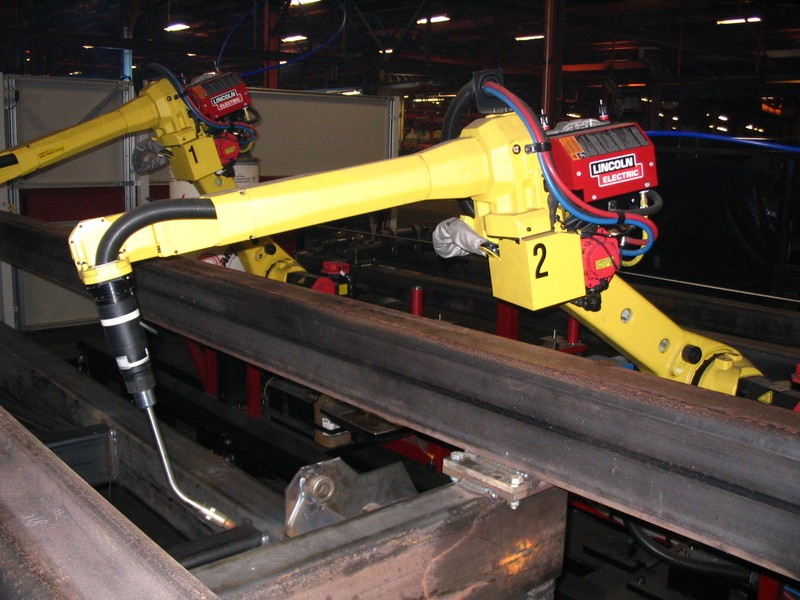
Image credit: Wikimedia Commons — "FANUC welding robot reaching.jpg" — CC BY 3.0.