

In Short

MIG is the better choice when speed, deposition rate, and deep penetration matter. TIG is the better choice when appearance, precision, and low heat input matter. CBOXTEC CTC-HJ and CTR-HJ arms can run both processes when fitted with the correct torch, gas, and parameters.

1. What MIG/GMAW and TIG/GTAW Mean

MIG, usually called Gas Metal Arc Welding (GMAW) in North American standards, feeds a continuous consumable wire electrode through a gun shielded by argon, CO₂, or a mixed gas. The wire acts as both electrode and filler.

TIG, or Gas Tungsten Arc Welding (GTAW), uses a non-consumable tungsten electrode to create the arc. A separate filler rod is added by hand or wire feeder, and argon or helium shielding gas protects the weld pool. The American Welding Society defines GMAW as an arc process with a continuous filler electrode, and GTAW as a process with a non-consumable tungsten electrode.

2. MIG Robotic Welding: When to Choose It

Robotic MIG is the default choice for high-volume production of carbon steel, stainless steel, and aluminum parts. It deposits metal faster than TIG because the wire feed supplies both electrode and filler.

Choose robotic MIG when:

  • Weld speed and deposition rate drive throughput
  • Parts are 1.5 mm thick or greater
  • Joint fit-up is repeatable within ±0.5 mm
  • Appearance is secondary to strength and penetration
  • You want spray, pulse-spray, or short-circuit transfer

CBOXTEC CTC-HJ arms, such as the CTC015-HJ1464 and CTC020-HJ2027, support standard MIG/MAG torches and pulse power sources with integrated cable routing for fast weaving motions.

3. TIG Robotic Welding: When to Choose It

Robotic TIG is preferred when the weld must look clean, when heat input must be tightly controlled, or when the base metal is sensitive to contamination. Aerospace, medical devices, food equipment, and precision stainless exhausts often specify TIG.

Choose robotic TIG when:

  • Weld beads must be smooth and free of spatter
  • Material thickness is below 3 mm
  • The alloy is titanium, nickel-based, or aerospace-grade stainless steel
  • Distortion must be minimized
  • Quality standards require precise arc start and stop control

Robotic TIG is more sensitive to torch angle, stick-out, and gas coverage, so programming takes longer. The CBOXTEC CTC-HJ series can be fitted with a GTAW torch and automatic wire feeder, letting shops switch processes without changing the robot platform.

4. Speed vs Quality Trade-Off

MIG wins on speed. A robotic MIG gun can deposit several kilograms of filler metal per hour, and Lincoln Electric notes that GMAW travel speeds are typically higher than GTAW. TIG wins on control. Miller Electric describes TIG as producing "high quality, clean welds" and giving "excellent control over the weld."

In robotic applications, the speed gap matters. A part that takes 90 seconds with robotic MIG may take three to five minutes with robotic TIG. The right choice depends on whether the downstream value of a perfect bead justifies the slower cycle time.

5. Typical Materials and Gas Choices

Material Common robotic process Shielding gas notes
Mild steel MIG Argon/CO₂ mix or pure CO₂ for deeper penetration
Stainless steel MIG or TIG Argon/O₂ or argon/CO₂ for MIG; pure argon for TIG
Aluminum MIG (pulse) or TIG Pure argon; TIG gives cleaner starts on thin sheet
Titanium TIG Pure argon, often with trailing shield
Nickel alloys TIG Pure argon or argon/helium mix

CBOXTEC CTC-HJ arms can be configured with the correct torch, gas regulator, and wire feeder for each material group. For shops that weld both steel and aluminum, swapping the torch and parameters on the same arm is faster than installing a second robot.

6. Programming and Robotic Considerations

MIG programs are simpler: the robot guides the torch while the power source controls wire feed and arc. TIG programs require more attention to torch angle, arc length, filler entry point, gas pre-flow/post-flow, and collision avoidance because the GTAW torch is often longer.

Hand-guided teaching on CTC-HJ arms lets operators record both MIG and TIG paths without writing code, shortening setup for high-mix shops.

7. Which Process Fits the CBOXTEC CTC/CTR-HJ Arms?

The CBOXTEC collaborative welding robot range is process-agnostic. The same CTC-HJ arm can run MIG/MAG today and GTAW tomorrow if the torch and power source are changed.

For example:

  • CTC007-HJ1077 — small brackets and thin sheet in MIG or TIG
  • CTC015-HJ1464 — medium frames, stainless furniture, and mixed MIG/TIG work
  • CTC020-HJ2027 — large panels, heavy torches, and high-deposition MIG
  • CTR008-HJ1450 — industrial-speed continuous production with either process

This flexibility matters in Southeast Asian job shops where batch sizes are small and part families change weekly. Instead of buying a dedicated MIG robot and a dedicated TIG robot, a single CTC-HJ arm covers both.

FAQ

Can one robot arm really do both MIG and TIG?

Yes. CBOXTEC CTC-HJ arms support both GMAW and GTAW. Change the torch, gas, wire feeder or filler system, and process parameters; the controller stores separate programs for each process.

Which process has lower spatter?

TIG produces almost no spatter. MIG can produce spatter in short-circuit transfer, but pulse-spray transfer greatly reduces it.

Is robotic TIG slower than robotic MIG?

Yes. Robotic TIG is generally two to four times slower than MIG on the same joint because deposition rates are lower and programming is more detailed. The trade-off is higher weld quality and less cleanup.

When should I choose MIG over TIG for thin sheet?

For thin sheet below 1.5 mm, TIG or laser welding usually gives better heat control. For 1.5 mm to 3 mm sheet in high-volume production, pulse MIG can be faster while still producing acceptable beads.

Next Steps

Send CBOXTEC your part photos, material, and annual volume. The engineering team can recommend the right process, torch, and CTC-HJ arm configuration: Request a quote.


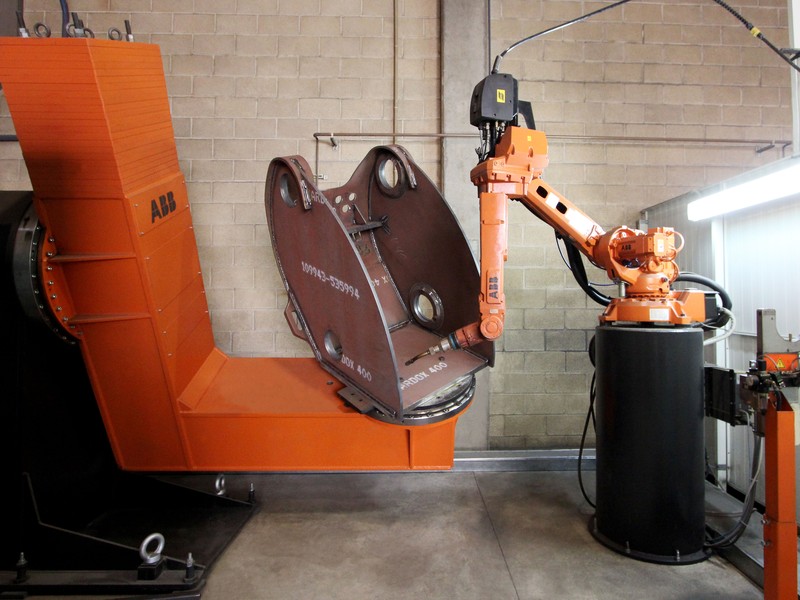
Image credit: Wikimedia Commons — "ABB welding robot.jpg" — CC BY-SA 4.0.

Sources

  • American Welding Society. "Gas Metal Arc Welding (GMAW)" and "Gas Tungsten Arc Welding (GTAW)" process definitions.
  • Lincoln Electric. "GMAW Welding" process overview.
  • Miller Electric Mfg. LLC. "TIG Welding Basics."