

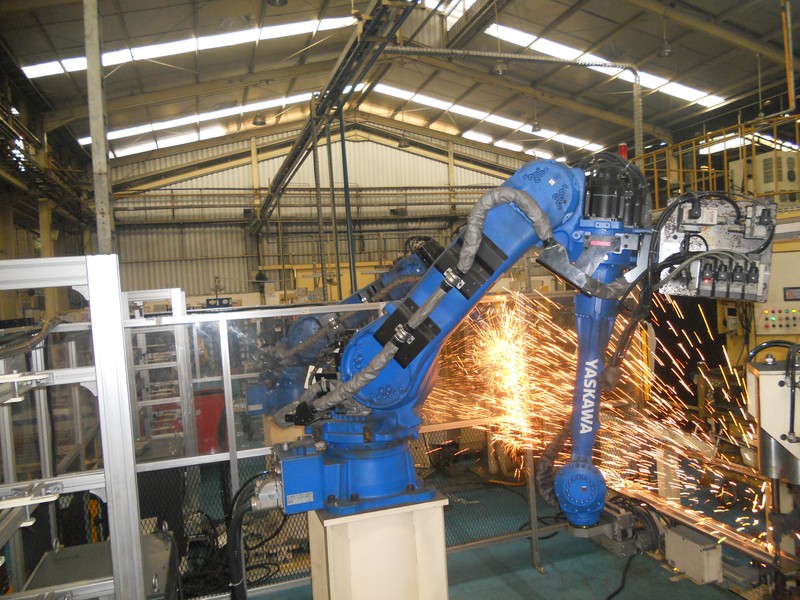
Compare the proposed installation
Choose a collaborative or industrial welding robot by comparing complete proposals against the same production task. Category labels do not establish a particular cycle time, price, footprint or safe operator interaction. These depend on the selected equipment, tooling, layout and validated application.
A useful comparison begins with a part family and a realistic work schedule. Record how often parts change, who loads and inspects them, and which tasks require access to the installation. Include the available floor plan and neighboring work areas.
Use the same comparison questions
- Production: what accepted output is demonstrated on representative parts?
- Changeover: what fixture, program and process work is required?
- Interfaces: which welding equipment and options are included?
- Layout: how are loading, maintenance and protective measures accommodated?
- Ownership: who supplies integration, documentation and acceptance work?
Compare exact model documentation and the entire operating sequence. A faster arm movement does not necessarily shorten the finished-part cycle if loading, inspection or downstream work dominates.
Assess safety at application level
A collaborative arm does not by itself make a welding installation safe for people nearby. Welding hazards and interaction with fixtures, tooling and other equipment still require assessment. The protective arrangement must follow the application review; neither a universal fencing exemption nor a universal layout can be inferred from the category.
See the safety planning guide and its official reference links when preparing that review.
Make commercial comparisons consistent
Compare equipment, integration, site preparation, training and acceptance within the same scope. Ask CBOXTEC to identify the proposed CTC-HJ or CTR-HJ configuration and unresolved application requirements in writing. Use trial evidence and documented responsibilities to support the selection, without assuming either category always costs less or produces more.
What evidence should I compare before choosing an industrial welding robot or a cobot?
Compare accepted output on the same representative parts and the full cycle, including loading, welding, inspection and changeover. Match the written scope for equipment, integration, site preparation, training and acceptance before comparing proposals; the robot category alone does not establish cost or output.
Prepare a project-specific comparison
The following questions are CBOXTEC procurement guidance. Confirm the proposed scope and acceptance criteria with your supplier.
- Ask both suppliers to quote the same part family, batch sizes, fixtures, welding equipment, protective measures and acceptance work. Separate included items from optional or buyer-supplied items.
- Request separate records for loading, welding, inspection and changeover using representative parts. Compare accepted parts over the complete sequence, including manual intervention and rework.
- Before choosing a category, list the unresolved reach, torch access, operator access and floor-layout questions. Use a sample trial to resolve them rather than assuming one category is always cheaper.